De minimis is now an entry-data problem
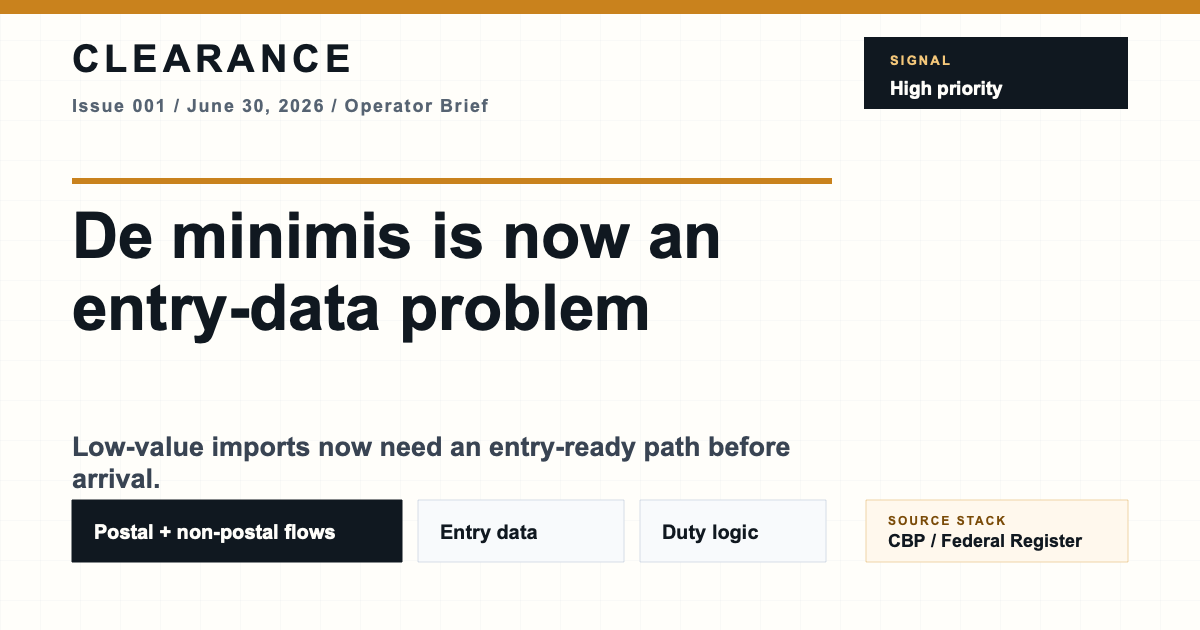
CBP split the low-value import transition by channel: non-postal is effective now, postal deadlines run July 24, September 22, and October 22.
Briefing Table
The issue in operating terms: change, impact, required action.
Exposure Matrix
Which flows move first, who owns the handoff, and what to check.
Dates / Watchlist
Dates that belong in broker, compliance, finance, and operations calendars.
CBP's June 24 actions turn low-value import planning from a duty-exemption question into an entry-data question, but the operational effect splits by channel. Non-postal shipments valued at $800 or less are outside de minimis as of June 24. Postal shipments remain on a staged regulatory path: the postal suspension is codified, most new postal informal-entry process changes take effect July 24, the Entry Type 13 test begins September 22, and specified compliance dates run to October 22.
The immediate risk is not just higher duty. It is a shipment arriving before the importer, broker, carrier, platform, or mail operator knows who has the classification, origin, value, quantity, authority, and process to make entry.
Who has the data, authority, and process to make entry when the shipment no longer clears under Section 321?
The Clearance Brief
1. Postal de minimis suspension is codified; the mail lane gets a new informal-entry process
CBP issued a rule codifying the suspension of Section 321 treatment for international mail shipments valued at $800 or less. The rule is generally effective July 24, with specified provisions reaching compliance on October 22.
Postal shipments now move toward an informal-entry model that requires usable HTS, origin, value, duty, quantity/weight, and party data.
Operator read: identify postal flows first. They have their own timeline, data requirements, and informal entry path.
2. Non-postal low-value merchandise also moves out of de minimis
CBP also suspended de minimis treatment for low-value merchandise arriving through all other modes, effective June 24.
This is the broader break. Express, air, ocean, truck, marketplace, and direct-to-consumer flows that leaned on the $800 rule now need a formal or informal entry path unless another exemption applies.
Operator read: do not treat this as a postal-only issue. The non-postal rule catches the rest of the low-value operating model.
3. CBP opens an electronic informal mail-entry test
CBP's operational bridge is a voluntary ACE test for new informal entry type 13, covering qualifying international mail shipments valued at $2,500 or less.
The test begins September 22 for qualifying mail entries, with participation and filing authority limited by the test notice.
Operator read: Entry Type 13 is the electronic mail-entry test to watch beginning September 22; it is not a cure for incomplete classification, origin, value, quantity, or PGA data.
Signals
Clearance friction
CBP has turned low-value imports into an entry-readiness problem. The weak points are predictable: vague product descriptions, missing 10-digit HTSUS classifications, unclear importer responsibility, incomplete origin/value/quantity data, and shipments with PGA, AD/CVD, quota, Section 201/232/301, or Chapter 98/99 exposure.
Who should care: customs brokers, ecommerce importers, platforms, carriers, 3PLs, and brands using international mail or sub-$800 direct-to-consumer flows.
Trade movement
Census advance goods data shows May goods imports at $313.4 billion, up $10.9 billion from April, while goods exports fell to $207.7 billion.
Cost pressure
BLS import/export price indexes show import prices up 1.9% in May, with fuel import prices up 12.5%.
Logistics pressure
Port of Los Angeles container statistics show May loaded imports at 449,370 TEUs, up 26.25% from May 2025. Drewry's World Container Index reached $4,166 per 40-foot container on June 25, up 5% for the week and the highest level since September 2024.
Operator read: import volume, price pressure, and freight rates are already elevated. Tighter entry data adds another source of delay, cost, and exception handling.
What To Do First
- Pull a sample of the last 30 days of sub-$800 imports and tag each shipment by mode.
- Split postal mail from every other channel.
- Identify which shipments lack clean 10-digit HTSUS, origin, value, and quantity data before arrival.
- Confirm importer of record responsibility, broker POA/authorization, and the data role for each platform, carrier, or mail operator.
- Reprice the customer-facing journey where duties, fees, or delivery timelines change.
- Escalate high-risk SKUs with PGA, AD/CVD, quota, Section 201/232/301, or Chapter 98/99 exposure before they get stuck in the new process.
Dates / Watchlist
- June 24, 2026: Non-postal de minimis suspension effective; CBP's postal suspension amendment is effective, while most new postal informal entry process changes follow the July 24 / October 22 timeline.
- July 24, 2026: Comments due on both interim final rules; most new postal informal entry process changes effective.
- September 22, 2026: ACE Entry Type 13 voluntary test begins.
- October 22, 2026: Compliance date for specified postal informal entry provisions in 19 CFR 145.12.
Operator Checklist
- Map current low-value flows by mode: postal, express, air, ocean, truck, marketplace, and direct-to-consumer.
- Confirm the importer of record for each flow, then confirm broker authorization/POA and who will transmit entry data.
- Audit product descriptions, 10-digit HTSUS classifications, origin, value, quantity, weight, and duty logic for high-volume SKUs.
- Update landed-cost, checkout, and customer-support assumptions where sub-$800 shipments were treated as duty-free.
- Flag shipments with PGA data, AD/CVD, quotas, Section 201/232/301, or Chapter 98/99 treatment for broker review.
- Export desk note: this issue is import-led because the CBP action affects low-value entry workflows. Future editions will cover export controls, sanctions, and outbound trade signals when they drive the operator calendar.
CLEARANCE is an open weekly trade brief for importers, exporters, customs brokers, and compliance teams. Free includes the weekly brief; Pro launches later at $29/mo or $290/yr.